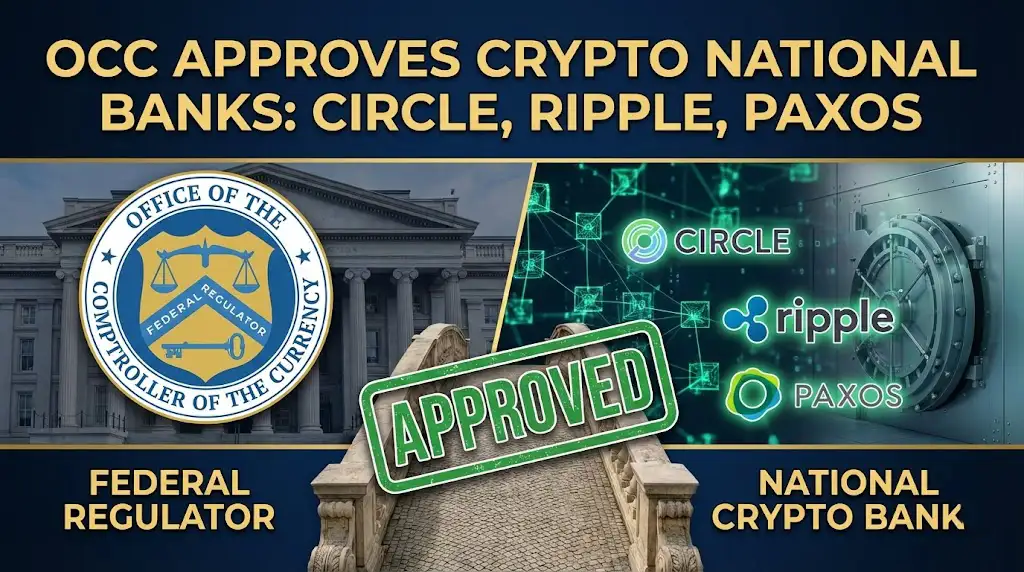
The Office of the Comptroller of the Currency (OCC) has officially opened the door between the cryptocurrency industry and regular finance. On Friday, the federal regulator made history by giving five of the biggest digital asset companies in the US Circle, Ripple, Paxos, BitGo, and Fidelity Digital Assets conditional national trust bank charters.
This is the biggest change in U.S. crypto rules ever. It allows these “crypto-native” businesses to follow the same federal rules as major banks like JPMorgan and Bank of America.
The “Big Five” and Their New Status
According to the official release, the approvals apply to specific new entities created by these firms:
- Circle: Approved to establish First National Digital Currency Bank, N.A.
- Ripple: Approved to launch Ripple National Trust Bank.
- Paxos, BitGo, & Fidelity: Authorized to convert their existing state-level trust charters (mostly from New York and South Dakota) into full national trust banks.
Comptroller of the Currency Jonathan Gould framed the decision as a necessary evolution of the American banking system:
“New entrants into the federal banking sector are good for consumers, the banking industry, and the economy. They provide access to new products, services, and sources of credit, and ensure a dynamic, competitive, and diverse banking system.”
Official Release: https://www.occ.gov/news-issuances/news-releases/2025/nr-occ-2025-125.html
The Guiding and Establishing National Innovation for U.S. Stablecoins (GENIUS) Act, which became law in July 2025, makes this wave of approvals possible.
Before this law, crypto companies were in a “regulatory limbo,” reliant on a hodgepodge of state money transmitter licenses. The GENIUS Act set up a clear legislative framework that says stablecoin issuers of a particular scale must get government charters or face stringent limits on how many coins they can issue.
The OCC also released Interpretive Letter 1188 at the same time as these approvals. This letter made it clear that national banks can do “riskless principal crypto-asset transactions,” which means that the business models of these new banks are now allowed.
Also, Jeremy Allaire, CEO of Circle, emphasized the impact on their stablecoin, USDC:
Establishing a national digital currency trust bank of this kind deepens Circle’s longstanding commitment to the highest standards of trust and compliance.” — [Source: Circle Press Release]
Note: This news was written by our editor, editted with the help of AI, and reviewed by our editor to ensure its accuracy and compliance with our standards.